
The Years
A decade of my life and 7 of Annie Ernaux’s

This week, I was lucky enough to spend my 31st birthday in Paris after a weekend at a friend’s wedding in a nearby town.
The wedding was perfect: I cried, I argued about literature with a French relative on a smoke break, we danced until 4:30 am.
The following Monday was my birthday, and my husband and I returned to Paris to continue the celebrations. We spent the day ducking the rain in cafes and museums before ordering a cut of prime rib so large it concerned our waiter. What is a birthday for, we decided, if not committing to extravagance?
By Tuesday, I was exhausted and running on 90% bread, cheese, and meat. My husband had to leave to return for work, but being relatively unemployed when I booked the trip, I had already planned to stay a few extra days in the city on my own.
Last time I traveled internationally on my own was nearly a decade ago, when I landed a temporary job on a horse farm in Portugal the summer after my college graduation. Every morning, I carted wheelbarrows of hay out to horses that shared a pasture with Roman ruins. During the day, I led foreigners on trail rides on old bandit roads, and in the late afternoons and evenings, drank beer and read by the local pool.
I didn’t have work lined up for myself when I returned, but I remember feeling anxious to “start my life.” I wanted the kind of job that my ambitious peers had already secured, the one that would validate the years spent in school, garnering me both an enviable paycheck and the respect I was craving. At the same time, I didn’t want any of that. I wanted to be an artist, to live on the horse farm and write, eschewing the career ladder altogether.
For the next 10 years, I danced between these two poles, trying to eke out a living and a respectable job while still pursuing my craft. I returned from that summer and got a marketing job, quit after a year, went to school for three years to get an MFA, ran out of funding, cycled through another few teaching and writing-related gigs, all while continuing to write, with and without success.
The angst I used to feel has quieted somewhat in the past decade. I no longer feel like my life hasn’t “begun,” nor do I expect to find my self-worth validated by my resume. When I projected myself into the future at 22, I imagined I’d have a lot more accomplished by now, both internally and externally, but that’s what everyone thinks at 22. At some point, one realizes that life does not follow a traditional plot structure. This is why reading novels is so enjoyable. It’s a break from the relentless uncertainty, the lack of control that governs our daily experiences.
I brought a couple of books to read with me on my solo traveling in the city, which so far, has consisted of cycling through museums, coffee shops, and bookstores—my dream itinerary. The first book I finished is Annie Ernaux’s The Years, an experimental memoir covering almost 70 years of the narrator’s life and, more broadly, French history.
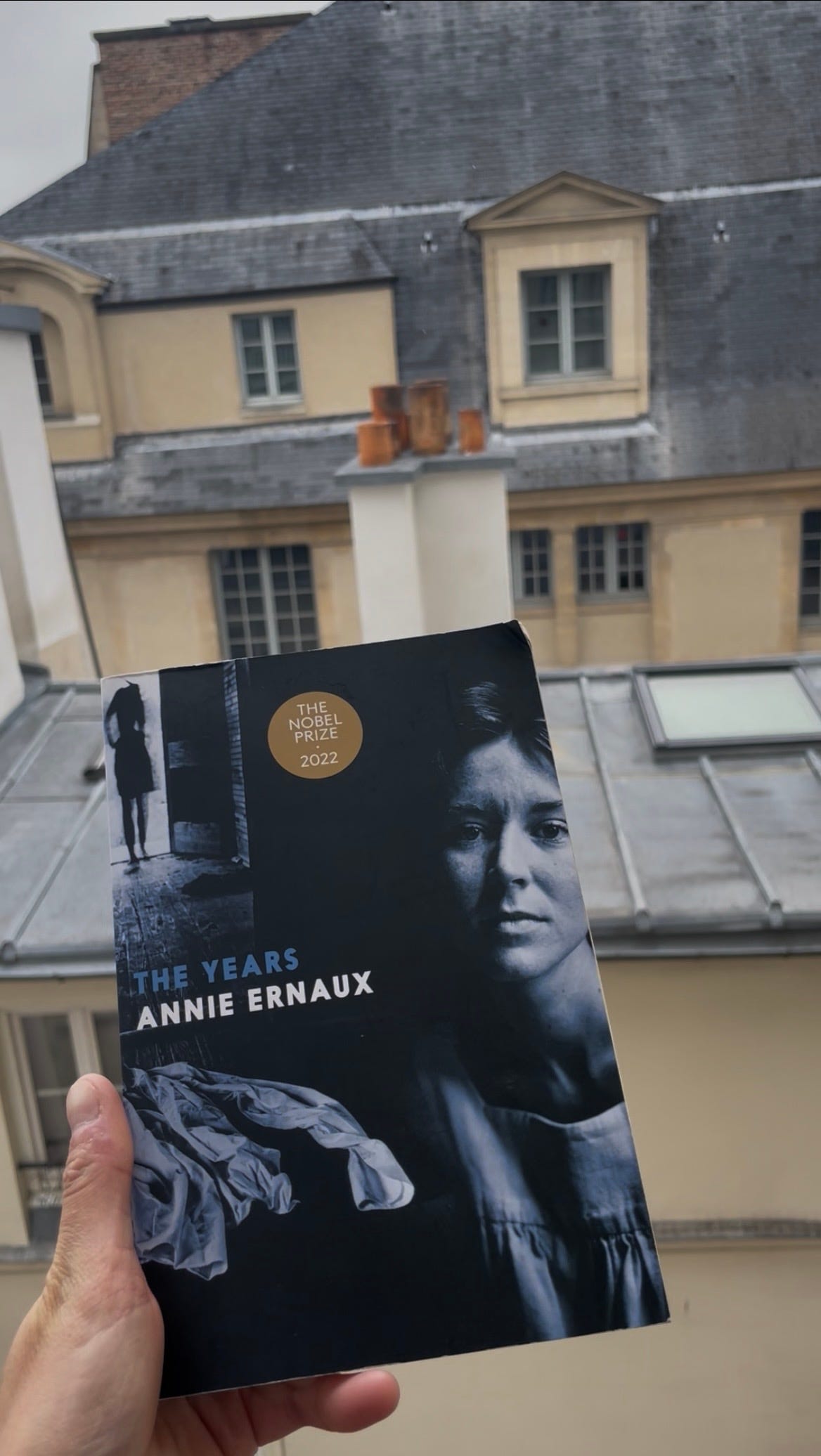
If you’ve read it, you know how difficult it is to describe. The “I” pronoun of traditional memoir has been replaced by “we” and “she” and “they.” Some passages are deeply personal, such as the narrator (she) looking back on old photos, or at herself in a mirror, and in other passages the narrator has almost disappeared entirely from the narrative, subsumed into a collective consciousness that carries readers from post WWII to the dawn of the internet.
The structure is chronological, but it lacks the security of a traditional plot. There are chapters that consist of fragmentary images, holiday dinners that extend for paragraphs and years that pass by in a few sentences. In this way, Ernaux’s work evokes the passage of time, the way it expands and contracts according to where we place our attention.
Ernaux writes early in the book that she wanted to capture something akin to Gone with the Wind or In Search of Lost Time, a work that interrogates the nature of memory as much as the memories themselves. Having read In Search of Lost Time earlier this year, I think Ernaux improves upon the author’s project, capturing the experience of time without burying us in the relentless interiority of one person’s mind. Instead, she transports us to a collective unconscious, more akin to Virginia Woolf.
I can’t think of a book like this—packed to the brim with so many details and events they’re impossible to remember, yet still carrying so much emotional weight. There’s the emotional weight of history—the wars, the injustices, the technology, the culture—and the weight of aging—coming-of-age, marriage, children, divorce, getting old.
Not all time is created equal. Adolescence and its lovers span dozens of pages, while the husband hardly makes an appearance. Memory, after all, is not democratic. When I think back to 10 years ago in Portugal, certain details linger. An afternoon drive in the back of a van in the heat of July, my arm out the window, listening to “La Flaca.” Eating a plate of fatty pork at a local festival while elderly couples danced to Portuguese polka all around me. I remember generally the way I felt and how I spent my days, but the big, important narratives that were happening in my life, like my relationship with my now husband, or the trajectory of my career, don’t actually belong to that era. They can only be understood in retrospect.
At first, I wasn’t sure I was going to like The Years, but the longer I read, the more the details transcended the sum of their parts. Their meaning, like the “meaning” of life (if there is one), lies in the experience of time itself, the compounding of memories.
Ernaux proves a point that is sometimes lost in reading creative writing or even non-creative writing. We read not to see how other people live or have lived, but to see how we do. At the end of the day, the difference between the personal and the collective is only a matter of circumstance, and by focusing on the details of the lives of others, we can learn to better see our own.
I can project myself 10 years into the future and imagine writing about this Paris trip. I don’t yet know what details will remain or how the larger narratives I’m now experiencing will play out. At 21, I couldn’t imagine 31, and at 31, I can hardly imagine 41, but I know that it will arrive as the years do, without fanfare or ceremony. It will arrive with the sense that one has come from somewhere and is going somewhere, without ever really leaving or getting there.
I loved this, Sophie. I feel we are a culmination of our past and that it plays a part in, but does not determine ,our future. ❤️
this is wonderful